Hamina Wireless Surveys in Germany

Hamina Wireless Surveys

For IT managers and network engineers in Germany dealing with complex building environments, dense construction materials, older infrastructure, multi-floor enterprise campuses, Hamina wireless design gives engineers the predictive accuracy and documented evidence they need to plan access point placement with confidence.

Rob White

Last Updated: 13/08/2026

Why Germany Specifically Demands a Rigorous Approach

Germany is not a simple wireless survey environment. A few realities make this market distinct:
Building construction. German commercial buildings often use reinforced concrete, thick masonry, and materials that attenuate RF signal heavily. What works on paper in a predictive model needs to be validated on the ground by engineers who know how to account for real-world signal loss.
Enterprise density. Germany’s enterprise landscape, manufacturing, automotive, logistics, financial services, means large, complex sites. Multi-building campuses. Warehouses with high racking. Healthcare environments with specific RF constraints. Each demands a tailored wireless network survey approach, not a templated one.
Regulatory and compliance expectations. German enterprise clients and their procurement teams hold vendors to a high standard on documentation, methodology, and reporting. A casual survey with a basic floor plan is not going to pass scrutiny on a major infrastructure project.
Growing demand. As enterprise Wi-Fi 6 and Wi-Fi 6E deployments accelerate, the need for accurate pre-deployment planning and post-deployment validation is growing. Getting it right at the survey stage avoids costly remediation later.
A professional Hamina wireless survey in Germany is not a commodity service. Treat it as one and you will find out why when you are back on site fixing access point placements three months after go-live.

What a Professional Hamina Wireless Survey Actually Involves

There is a significant gap between a basic site walk and a properly executed wireless survey. Here is what a rigorous process looks like:
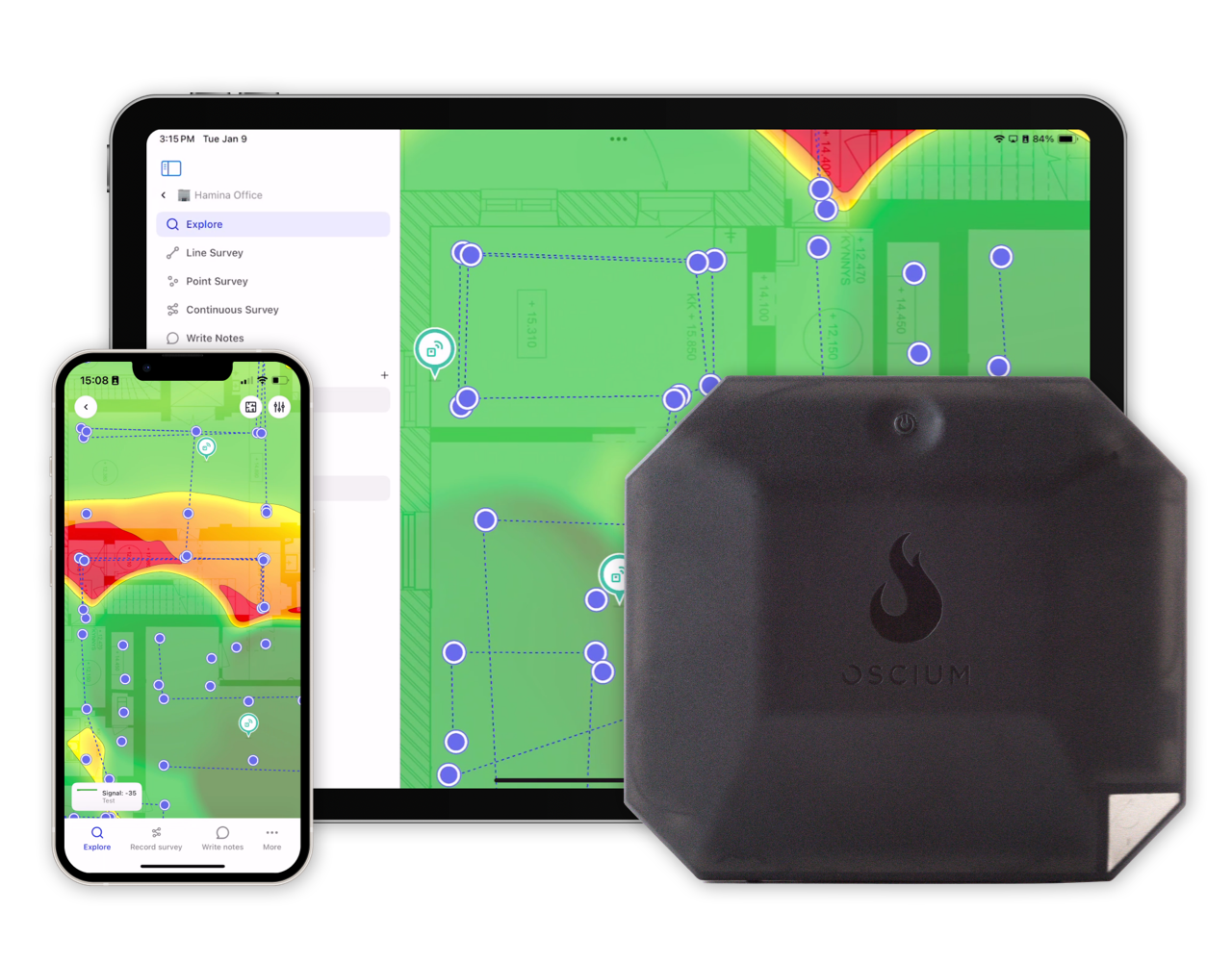
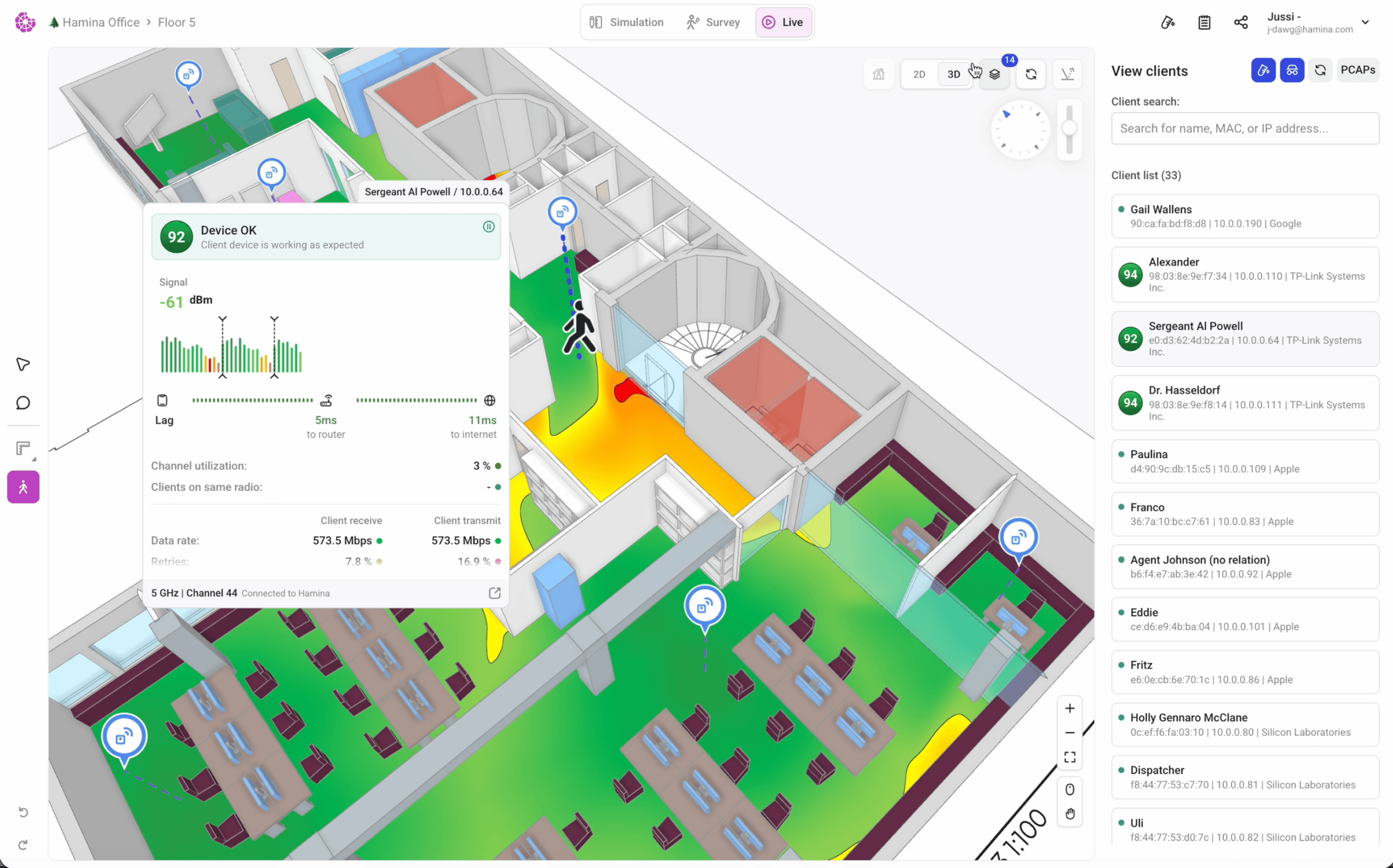
Pre-survey planning. Before anyone sets foot on site, the survey team works from floor plans, building specifications, and client requirements to build a predictive model using Hamina wireless design. This establishes expected AP placement, density, and coverage patterns before the site visit.
The site walk. Engineers conduct a systematic physical survey of the environment, validating signal propagation against the predictive model, identifying interference sources, documenting obstructions, and capturing real-world RF data. For enterprise Wi-Fi Germany engagements, this means every floor, every wing, and every edge case the client needs covered.
Heatmap generation and analysis. Signal coverage, signal-to-noise ratio, channel utilization, and secondary coverage are all mapped and reviewed. Problems identified here are far cheaper to fix now than after deployment.
Reporting. This is where the survey becomes genuinely useful to the people who have to act on it. A professional wireless network survey report covers findings, recommendations, access point placement guidance, and the supporting data, presented clearly enough that a procurement lead or project manager can understand it, not just a radio engineer.
It is worth noting: the quality of the reporting is often what separates a good survey firm from an excellent one. Data is only valuable if the people who need to use it can actually read it.

Why Choosing the Right Survey Partner Matters More Than Choosing the Right Tool

Hamina is a capable platform. But the tool is only as good as the engineer using it.
Here is what separates a certified, experienced survey team from someone running the same software with less rigour:
Methodology. An experienced team knows which survey type is appropriate for which environment. Active surveys, passive surveys, predictive validation, these are not interchangeable. Getting the methodology wrong means getting the data wrong.
Consistency across sites. If you are managing a multi-site rollout across Germany, or across Germany and several other countries, you need a partner who can deliver the same quality of output every time, regardless of which engineer is on site. That requires standardised processes, not individual interpretation.
Reporting that holds up to scrutiny. The survey report is often a contractual deliverable. It needs to be accurate, complete, and professionally formatted. DIY tools and generalist IT firms frequently underdeliver here.
Speed. Enterprise projects have timelines. A survey partner that takes three weeks to produce a report is a blocker. You need a team that can move from site visit to final report within days, not weeks.

FNG's Credentials and Approach for Wireless Surveys in Germany

Fortitude Nicsa Global delivers professional wireless survey services across Germany and over 150 countries worldwide. Wireless surveys, including enterprise Wi-Fi Germany engagements, generate approximately 50% of our global revenue. This is not a side capability. It is central to what we do.
A few specifics worth knowing:
6,500+ engineers globally. For German clients with operations in multiple regions, FNG can deploy across EMEA and beyond with the same team and the same standards.
ECSE-accredited reporting team. All survey reporting is handled by our UK-based, Ekahau Certified Survey Engineer-accredited team. This ensures every report, regardless of where the site walk took place, meets the same professional standard. We work with Hamina as part of our toolset, bringing that same rigour to Hamina wireless design engagements.
98% SLA achievement. We are serious about timelines. From customer sign-off to site visit, we typically mobilise within a week. Reports are delivered within seven days of the survey. That is not a target, it is what we actually achieve.
Vendor agnostic. Our engineers hold certifications across Cisco, HPE, Juniper, Dell, Lenovo, and more. We survey the environment; we do not have a vendor agenda influencing our recommendations.

The Recommendations

Before installing any access points, you should always conduct a pre-deployment survey, guesswork has no place in network planning. Use Hamina’s predictive planning tools to model your environment in advance, and make sure your floor plans are accurate before getting started. When carrying out the survey, use a certified wireless engineer to ensure the results are reliable and actionable. Once complete, act on the findings promptly, use the data to prioritise access point placement and share the report with your IT team and network vendor so everyone is aligned. Finally, treat this as an ongoing process, schedule regular re-surveys as your environment changes and follow up with a validation survey after installation to confirm everything is performing as planned.

Ready to Validate Your Wireless Infrastructure?

If you’re planning a Hamina wireless survey, or any project where wireless reliability is business-critical, conducting a survey before installation is one of the most cost-effective steps you can take. It’s far cheaper to reposition an access point before the ceiling tiles go in than after.

Book a free discovery call and let’s talk about what your project needs: fortitude-nicsa.com/book-a-discovery-meeting

Discuss A Hamina Wireless Survey Installation With FNG

Want to find out more about our Hamina Wireless Survey Options? Schedule a call with us today to see how we can help.

Book A FREE Discovery Call

About the author:

Fearn Mclaughlin